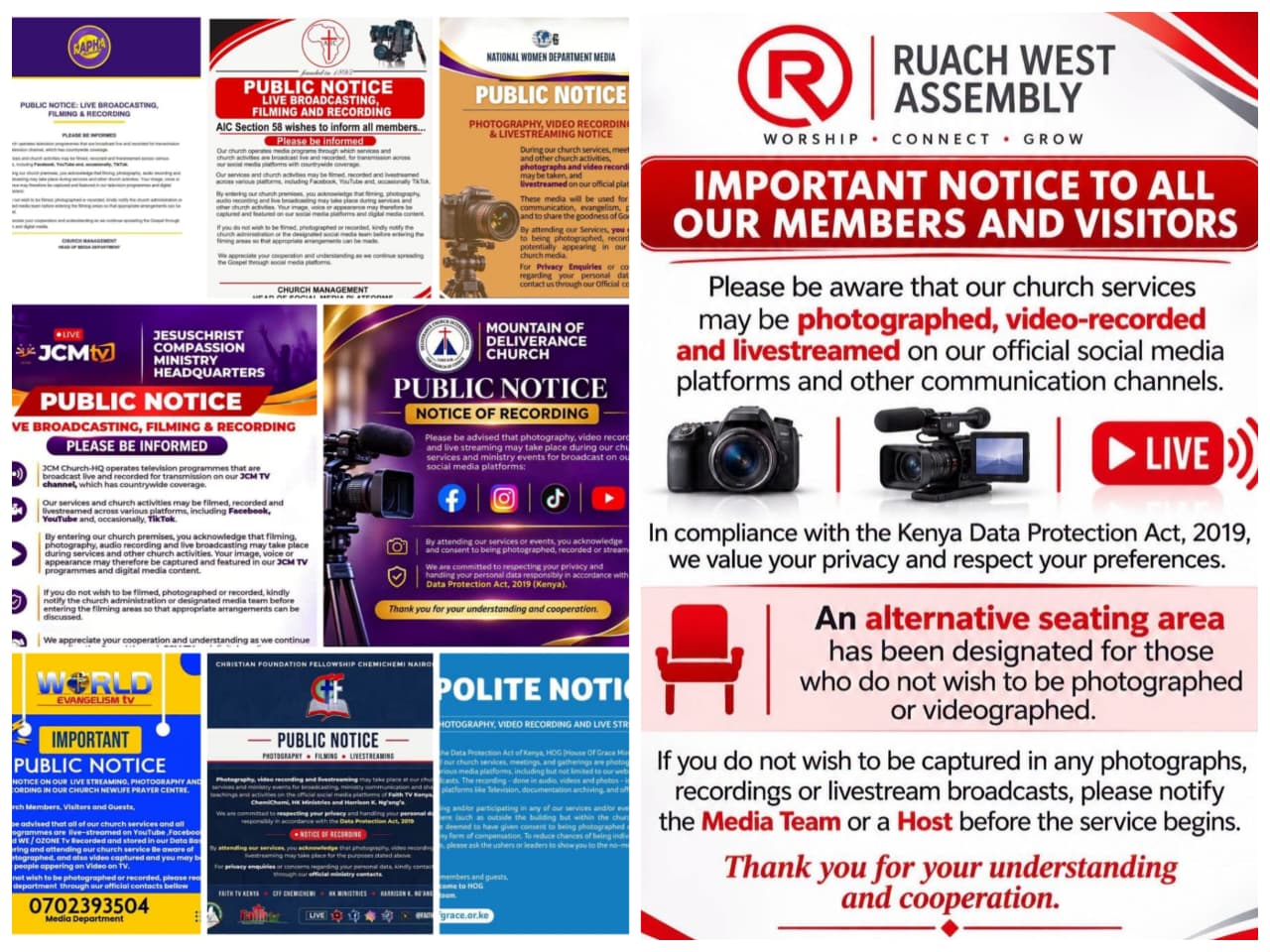
Several churches in Kenya have recently circulated public notices informing congregants that their services may be photographed, video-recorded and livestreamed on social media. Some have gone further, declaring that anyone entering their premises automatically consents to being captured and appearing in online content.
While informing congregants is good practice, there is a fundamental misunderstanding: A public notice is not consent. Walking into a church is not consent. Attending a worship service does not mean surrendering your right to privacy.
Under Kenya's Data Protection Act, 2019, consent must be freely given, specific, informed and unambiguous. Simply displaying a poster declaring that attendance amounts to consent does not satisfy these requirements.
The Office of the Data Protection Commissioner (ODPC), through its 2025 Guidance Notes on Processing of Personal Data for Publication of Recorded Media, distinguishes between notifying people about recording and obtaining their consent.
Ruach West Assembly: A Step in the Right Direction
Among the notices reviewed, Ruach West Assembly's approach is slightly more considerate of congregants' privacy.
Unlike churches that rely entirely on blanket declarations of consent, Ruach provides an alternative seating area for people who do not wish to be photographed or recorded. It also encourages congregants to notify the media team or a church host before the service.
This is a practical approach that recognises people's right to choose whether they appear in church media. The ODPC guidance also identifies designated seating areas and opt-out arrangements as practical ways of respecting privacy preferences.
However, this does not automatically guarantee full compliance. The media team must ensure that people in the designated area are genuinely excluded from photographs and livestreams. The church must also explain how recordings are used, stored and shared.
Churches Must Understand That Images Are Personal Data
A photograph of an identifiable person is personal data. So is a video capturing someone's face or voice. Recording, storing and publishing such material amounts to processing personal data.
Churches undertaking these activities must identify an appropriate lawful basis for processing and comply with the principles of transparency, fairness, purpose limitation and data minimisation.
Consent is not the only lawful basis under Section 30 of the Act. However, whichever basis a church relies on, it cannot ignore people's privacy rights.
For instance, a church livestreaming a sermon can focus its cameras on the pulpit and preacher rather than unnecessarily broadcasting the faces of hundreds of congregants.
Children also require special protection, including appropriate parental or guardian consent where required.
What Churches Should Do
Churches do not need to stop livestreaming or documenting their activities. They simply need to do it responsibly.
They should provide clear privacy notices explaining why recording takes place and where content will be published. Where consent is the lawful basis, they should obtain it through a clear and voluntary process. They should also establish genuine opt-out arrangements, position cameras responsibly, protect children's images and have proper procedures for storing and retaining recordings.
Worship Should Not Come at the Expense of Privacy
Churches have every right to embrace technology, broadcast sermons and reach audiences online. However, the desire to grow digital audiences cannot override the rights of the people attending their services.
A congregant should not have to choose between attending worship and protecting their privacy. Neither should declining to appear in a livestream be interpreted as a lack of faith or commitment.
Ruach West Assembly offers a more thoughtful starting point by providing alternative seating, but all churches must recognise that a public notice is only the beginning of responsible data protection practices.
You can preach to the world, livestream your services and share the Gospel online. But you cannot make consent compulsory simply because someone has walked into the house of God.
Respecting privacy is not an obstacle to ministry. It is part of respecting the dignity of the people churches exist to serve.